Romain Jerome Chrono Tourbillon Limited Edition is immediately recognized by its steel oxidised bezel. This bezel has become a signature standard for the DNA line. The bezel is oxidized individually in water to achieve a unique bezel footprint meaning no two Romain Jerome Bezels will have the same oxidisation pattern. The chronograph skeleton dial frames three sub dials incorporating the tourbillon and chronograph readouts. Three models of this watch will be available crafted in a steel case, a black PVD steel case or an 18k red gold case. But don't get the "gimmes I must have this watch" just yet Only 9 of each model will be available and the price will run you from about 199,000 - 219,000 Swiss Francs.
Although I love this watch I was kind of hoping that Romain Jerome would release a Titanic 100 year commemoration timepiece, since it was exactly 100 years on April 15th, since the tragic disaster occurred. After all Romain Jerome has fashioned its watches with steel from the Titanic and has taken great lengths to fuse this history into the actual components of the watch. We'll just have to wait and see.
Thursday, February 2, 2012
Steam Punk Watches A New Dimension of Time Telling
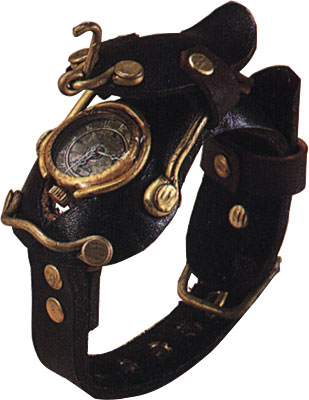
What is it with steam punk and watches, and I say everything. Steam punk is gears, steampunk is clocks and leather and rust and joints and levers mechanic, as if the object has a life of its own in a time far gone or a time yet to come. I happened upon this website and the name alludes me simply because its title is in Chinese or Japanese or Korean (I think). But where as I had trouble understanding the words, I had no trouble understanding the timepieces- they are steampunk all the way.
Steampunk is a curious genre in that it evokes a mysterious emotion, one cannot quite grasp. What exactly is it, well its interpretation cannot fit within the neat little description upon the pages of an Oxford Dictionary. The genre has enabled watch makers to use old watch parts to create original timepieces.
The most famous steam punk luxury watch out there at the moment, unveiled in the latter part of 2010, is Romain Jeromes Steam Punk watch. One almost to expect a hiss of steam to erupt from the seconds hand "air vent"aperture. The oxidised steel besel is almost a steam punk must have evoking the sense of metal exposed to harsh environments. The dial resembles the steel girders of a giant structure. This image is achieved by the use of the four polished screw down pistons and the imposing Roman Numerals at the 12 and 6 'o'clock position.
Another watch company pushing the Steam Punk Genre is Retrowerk Watches. Retrowerk watches combines German craftmanship, swiss movements and interesting application of the steam punk genre. I like to call it soft steam punk or part steam punk. Actually my favorite part of these watches, is the highly reliable ETA 2824 movement, since there are so many steam punk gimmicky
watches, I feel if the movement is an ETA movement then the exterior of the watch must be of good quality. The Retrowerk Compass Brass looks like it would be more at home around the wrist of a sea captain rather than in the bowels of a great hissing heaving city. So what else to I love about this watch.
- Stainless Steel is high quality 36L - with worn brass finishing
- Screw down crown cover and case back increasing water resistany capabilities to 200 meters.
- I love the Detachable Compass Module!
- The half dial time display is pretty cool.
Steam Punk is a rather curious genre where descriptions are based on an individuals perception. However it is often described as a sub-genre of science fiction and fantasy combined with mechanical contraptions, dark intentions and swirls of the supernatural.
Thursday, January 26, 2012
America's First Woman Watchmaker CEO.
In 1890, three brothers launched a successful watch company, so successful that kings, actors, explorers, navigators and astronomers from around the world used their timekeeping instruments. By 1916, all three brothers had died leaving the million dollar business in the hands of their sister. She knew of the business only through discussions at the dinner table, as she was their home-maker, but had very little horological training; however, she felt a tremendous responsibility to the then 60 year old enterprise baring her family name and she, Martha Wittnauer, learned every aspect of the watchmaking business. The Wittnauer watchmaking business.In 1872, young Albert Wittnauer, then just 16 and already a skilled watchmaker, arrives in New York from Switzerland to work for his brother-in-law J. Eugene Robert, a watch importer. Two years later, he is joined by his older brother ,Louis. Albert is now quite familiar with the American Watch Market and wants to provide them with a watch having the same functionality and durability as the Swiss imports but priced much lower, thus, in 1880, the Wittnauer Brand is born. America loves the watches and in 1890 J. Eugene Robert transfers the business to Albert. On Maiden Lane, in the hub of New York's jewelry and watchmaking business, the company employs only the best including H.A. Lungrin (inventor of the chronograph system); Ferdinand Haschka who went on to become the head watchmaker at Tiffany & Co, and Charles Johns, who years later crafted a 80-jewel perpetual calender chronometer displayed at the 1939 World's Fair. It was in 1899, when Louis died of tuberculosis and Albert spend more and more time in Geneva overseeing the watch productions. Emile managed the New York offices.
Explorers ventured to uncharted territory, and A. Wittnauer Company became the watchmaker of choice. The accuracy of their chronometers was renowned and used by navigators, explorers, geographers and navigators.
It is interesting to note, in 1904, Albert Wittnauer incorporates the A. Wittnauer Company. He as the president and his brother Emile as vice president, no mention is made of Martha Wittnauer. Women in America at this stage had very little say as the 19th Amendment granting women equal rights was still 16 years away. Martha although adored by her brothers and an able homemaker had no say nor part in the company.
Under the extremely talented Albert Wittnauer, Wittnauer watches became the first company to adapt its watches to aviation. In the dawn of the twentieth century, many aviation pioneers, celebrities, political figures and explorers wore a Wittnauer watch. Amelia Earhart, Richard E. Byrd, Howard Hughes, Kingsford Smith and a host of others dependent on the precision of a Wittnauer chronometer.
In 1908, Albert dies of tuberculosis at the age of 52 and Emile takes charge. Wittnauer now moves uptown to 36th street. In 1916, Emile dies, and now the company is left to Martha Wittnauer, their sister. It is a time when very little women are in authoritative positions. Most women were either working in factories or sitting in parlors. It was a man's world, where women had very little say in matters. Martha felt an overwhelming strength of responsibility, and judging from her almost immediate control of matters she was a women of incredible resolution.
There are many company histories of young entrepreneurs building up huge fortunes and successes, but the incredible step Martha took, influenced America's view of women.
In the 1920's, Martha told a reporter at The Lima News: Running a watch business has many things in common with homemaking tho. The same principles underlay both - harmony. Given good craftsman, and encourage them to co-operate and the outcome is sure to be harmonious.
Martha was a compassionate boss who provided security to her staff, some of who remianed at the company for upwards of 35 years. She understood when an employee needed to return home to Switzerland every summer to attend to his Alpine goats, or when another employee child or wife was ill.
She was the first women to be elected into the Horlogical Society of America. Under her supervision, the Wittnauer watches aided the War efforts. In 1918, Wittnauer introduced the Wittnauer All-Proof, the first waterproof (term no longer used), shock proof, anti magnetic watch. The incredible resilience of the timepiece was dropped from airplanes, flung from the Empire State Building, ventured into the Amazon Jungle and climbed the Himalayas, Alps and Andes. The company creates a Wittnauer aircraft watch for the U.S. Army Air Corps the first clock designed specifically for a military aircraft. In 1926, it is the A. Wittnauer Comapant providing the official timing for America's first radio network - The National Broadcasting Company.
An A. Wittnauer timepiece assist the success of countless historic events:
- Richard E. Byrd and Floyd Bennet consults an A. Wittnauer timepiece while flying over the North Pole, a first for mankind.
- In June of 1926, Clarence D. Chamberlin and Charles A. Levine, completed the first trans-Atlantic flight in "Columbia", their Wright-Bellanca monoplane.
- In 1928, Captain Charles B.D. Collyer and John Henry Mears circle the globe in 24 days by air and sea thus surpassing the orbiting moon by three days. They used A.Wittnauer timepieces to track their time.
- In 1932, Amelia Earhart became the first women to fly solo across the Atlantic in her Lockheed Vega-5B monoplane equipped with A. Wittnauer timepieces.
In 1936, in the midst of the depression, the sale of luxury items is suffering and Martha Wittnauer decides to sell A. Wittnaurt to Hella Deltah Company, a successful pearl manufacturer. The sale would ensure the survival and success of the company.
Now Wittnauer is part of Bulova and is manufacturing timepieces with the same longstanding tradition and high accuracy attained by the original Wittnauer siblings.
Wednesday, January 25, 2012
Roger Dubuis New Velvet Collection Whispers to Women
Roger Dubuis releases a passionate collection of ladies watches - The new Velvet Collection. The piece resembles a cascading evening gown accentuated by fine jewels. The Velvet Amethysts and Spinels piece, of which only 188 shall be available, exudes a royalty of character emphasized by the color combination of rich deep purple and shimmering black. The purple is due to the rich color choice of the purple amethyst and purple Spinals.
If you are not familiar with the term Spinal, don't be to disheartened, Spinals are precious gems in themselves - thought to be part of the Corundum family. The red spinals are often confused with rubies, but in fact are quite different stones. Spinals are found in a variety of colors - the red and cobalt blue spinal. The purple color spinal owe its hue to iron and chromium. Spinals require very little treatment as in nature they are flawless and transparent. Amethysts and spinals have slightly different refractive indexes creating a mysterious -almost unconscious - perception of contrasts on the bezel. A 36 mm black titanium and DLC case exudes a subtle sense of power.
The dials, numerals and applique darken beneath a coating of DLC (Diamond Like Carbon). However DLC is not merely to set the mood - turn down the lights (if you know what I mean) . A surface treated with DLC increases its hardness to that of Sapphire and 5 times that of steel. DLC increases the scratch resistance, durability and resilience of the surface as well as reducing friction. The dial further plays with the light by utilizing a black brushed sunray effect surrounded by purple elongated Roman numerals.
This model is also available in white gold smothered in no less than 100 diamonds totaling 1.77 carats. (left inset)With gratitude to Roger Dubuis, the New Velvet Women's collection is powered by a Roger Dubuis in-house RD 821 automatic mechanical movement. The movement was designed, developed and produced in-house.
A signature mark of this new collection is the bejeweled lugs which fit smoothly into the case making the transition between watch case and strap not a transition at all, but a seamless flow of elegance.
This model fulfills the new requirements for the Geneva Seal, a feat of which only a handful of watchmakers have achieved. To date Roger Dubuis - the first watchmaker to meet the new criteria for the Geneva Seal- is the only watch manufacturer to have 100% of its new watches to reach the demands required for the new “Poinçon de Genève”. Click here to read about the new “Poinçon de Genève” requirements.
Amethyst Greek Mythology:
This timepiece has an alternative function other than creating an image of exalted elegance and precisely indicating the time. Alternative function that is if you relate to Greek Mythology. The Ancient Greeks believed the amethyst had the power to prevent drunkenness. Even the word amethyst is derived from the Greek word - "amethystos" - "not drunken". So pertinacious they were in their belief, they even had wine goblets crafted in amethyst. In Greek Mythology the young maiden, Amethystos, was insistently pursued by the god of drunkenness and wine ,Dionysis. She refused his advances and prayed to the gods to remain chaste. Her prayers were answered by the goddess Artemis who transformed Amethystos into a white stone. So taken by Amethystos's fervent wish to remain chaste, Dionysus poured wine over her white stone as an offering. The wine dyed the crystal purple.
Saturday, January 21, 2012
The Mysterious Chinese Tourbillon and the History of Chinese Timekeeping.
What you are looking at is a genuine tourbillon crafted in China by horologically gifted Kiu Tai Yu.Why has Kiu Tai Yu named his watch the Kiu's Mystery Tourbillon? Well we will come to that later, but first lets see how a Mao Zedong medal maker from Soochow (near Shangai) crafted the first Asian Tourbillon.
Although, Kiu Tai Yu was born in China, and not in the Swiss valleys, he was drawn to watchmaking. His friends at school brought old heirlooms and broken mechanical watches, and Kiu Tai Yu fixed them to perfection. He was mesmerised by the mechanical workings of the timepieces and drawn to the art of watchmaking.
Although China is not usually associated with complicated watch making, its history spans a thousand years. In the year 1088, 11th century Chinese engineer, polymath, diplomat, astronomer and prolific writer, Sung Song, created Su Song’s "Heavenly Clockwork" tower.
The Tower was a remarkable feat of precision timekeeping of that time spurred by a small discrepancy in time. A discrepancy of a full month. Su Song - in the time of the dragon throne - arrived a full month early to a meeting between him and certain northern barbarians. Su Song (1020-1101) ,who was not used to be kept waiting, was actually scorned at his obvious lack of even the most rudimentary of timekeeping
. Thus Su Song's "Heavenly Clockwork"- a water driven astronomical clock tower was built. A mechanical masterpiece, even by today's standards, was 10 meters high and consisted of five stories. It was a pagoda-like structure which used flowing water to turn a giant water wheel at a precise, steady rate made possible by an escapement. Wheels, shafts and levers worked in perfect unison to signal, with the aid of puppets, bells, drums, gongs, and whistles, quarter hours. The escapement, now known as Su Song's escapement, kept the water running at a steady rate . Positioned at the very top was a large armillary sphere and a celestial globe portraying the position of the stars. The sphere and globe were able to indicate errors made by official astronomical observations.(Inset - Museum prototype)
China's long history in time keeping dated back even further to the year 723. In the days of the Tang Dynasty the escapement was applied to a water powered armillary sphere and clock drive.
Thus China's modern day watch maker, Kiu Tai Yu, stands in good company.
There was a complication above all others that intrigued Kiu Tai Yu, the tourbillon. Invented in 1795 by Swiss watchmaker Abraham-Louis Bregeut, a tourbillon was said to counter the effects of gravity on a pocket watch. In a traditional tourbillon, the escapement and balance wheel rotates in a cage at one rotation per minute; however,in 1993 Kiu Tai Yu introduced a tourbillon which required no bridge or carriage. This invention was just two years after he created the first Asian Tourbillon.
When the timepiece was unveiled the question on all watch aficionado lips was:
Lacking a bridge or carriage, how was the tourbillon supported?
The effect was indeed mysterious and created quite a stir among European watch makers. Kiu Tau Yu had achieved this illusion by suspending the balance-wheel atop its spring from a transparent bar of crystal. Kiu Tau Yu reduced the carriage to its barest functional necessity, fashioned it in the like of a pair of fish, and pinned one to the balance-spring.
Born in 1946, Kui Tai Yu made his first mechanical watch at 23; in 1978, he crafted an escapement without pallets and in 1980, Kiu Tau Yu moved to Hong Kong and opened his shop Kew and Cie - dealer in clocks and fine wrist and pocket watches.
Since, 1993, Kiu Tau Yu has created many more one-of-a-kind tourbillon watches, which all have a distinctive Chinese look. Utilizing lacquer, gold, red, curves, and Chinese ideograms, Kiu Tau Yu has created a unique look coveted by watch collectors. Each watch is a single unique work of art drawing on Ancient Chinese architecture for inspiration.
Kiu Tai Yu, has studied all possible technical aspects of the tourbillon enabling him to redesign this compelling complication. It is amazing to note that every timepiece crafted by Kiu Tai Yu, from case to dial, to movement within, is entirely handmade .
His craftsmanship techniques are so well respected that his book "Time in Pocket"was adopted by a Swiss watchmaking school as a standard reference work.
As far as I can tell the Tourbillon No.14, called "Joy of the Millennium", crafted wholly in platinum, is his latest piece. This piece is unique in its dial organization in that a large upper bridge supports the tourbillon carriage. The hour indicators are off-center and in the lower part.
When one thinks of China and watches, one generally thinks of plastic bubblegum watches stamped with cute cartoon characters or cheap replicas manufactured by the hundreds of thousands. One does not think of fine cutting edge horological craftsmanship, but let that not deter you, because one must remember China has been in the business of precision timekeeping for very long. Very long indeed.
China's economy has surged past Japan to become the second largest global economy, and luxury items are in high demand. Luxury items such as fine timepieces crafted to perfection.
Friday, January 20, 2012
The man behind the Movado Museum Watch.

Perhaps one of the most recognizable watch today is the Movado Museum Watch. Clearly identifiable, even from quite a distance away, is the large dot at the 12 'o'clock position symbolizing the sun at "high noon". The watch is genius in its simplicity, and timeless in design.
This watch is the brain child of Nathan George Horwitt. Born in Russia, he came to the United States as a young boy. He attended City College and NYU; he then studied at the Art Students League of New York.
Nathan George Horwitt served in the army in World War I, returning home, he joined E.R Squibb & Company as an advertising copywriter. Eventually he became the director of advertising. Nathan was becoming antsy,he felt the world was lagging behind in innovations and fresh ideas.
"Even in a Depression, we need to know the time in newer more innovative ways," he thought.
In the 1920's Nathan was brimming with ideas, and thus opened a company in Manhattan called Design Engineers. He would patent an idea and sell it to a manufacture. Only just managing to get by, he closed the company after just three years. However, Nathan creative mind could not squash the flow of idea's. Consequently in the 1930's he patented idea after idea,18 in all ,many of which were watch related.
Nathan had one basic idea. If he wanted to know the time, he did not wish to stop and study his watch cluttered with Roman Numerals, and an insistent second hand. Nathan admitted he did not have to keep track of the seconds, but rather wanted a watch that could tell the time with a quick glance. In addition, he wanted a watch that would please him with a simple elegant beauty.
Nathan first designed the "jump clock", and Cyclometer, the latter having a construction which allows the hour numerals to be large in relation to the size of the clock. Both patented around 1936, were highly praised by authorities in the field of time pieces; however, these clocks never made it into the manufacturing stage as this would require complete retooling of the existing machinery. No one at this stage would take the chance.Thus, during the next 20 years, Nathan's patented brilliant, innovative ideas struggled to take hold.
In 1954 Nathan entered his latest innovative idea as "the dot at the top" watch. Initially the watch was rejected by the patenting office, stating that the dial of this watch was not an innovative idea and thus could not be patented. Nathan did not give up, backed by a multitude of personalities in the design, he pushed forward.
Edward Steichen, an expert on design as the Director of Photography in the Museum of Modern Art said at the time ..." I believe that your design for the face of a watch is the only really original and beautiful design I have ever seen..."
Nathan received his patent, but still struggled to find a company who would take the risk of producing a watch with a modern, cutting- design. Nearing the end of 1960, Movado, a Watch Company formed in 1881 by 19 year old, Achille Ditesheim, recognized the design as an icon of modernization and decided to add "the Museum Watch" to its collection.
In 1960 Nathan's "dot-at-the-top" Watch Dial became part of a permanent collection of the Museum of Modern Art. It was the first Watch Dial to be awarded this distinction. Thus the "dot-at-the-top Watch became known as the "Museum Watch".
Nathan Horwitt was indeed ahead of his time. His "Museum Watch" is still highly popular, stunningly simple, and aesthetically beautiful.
Nathan Horwitt died in 1990, at the age of 92
Thursday, January 19, 2012
New Hublot King Power Unico GMT Bares a Striking Resemblance to Urwerk 103
The Hublot King Power Unico Gmt is an incredible feat of watchmaking technology, but although the movement is a brand new in-house Hublot construction, it bares a striking resemblance to the Urwerk 103 collection - save for the analog time display. All comparisons aside, I think the Hublot King Power Unico GMT is an exciting step into the companies consistent focus at innovative time display.
The new time display enables the timepiece to track 24 different timezones which are located on the bezel and at an angle on the edge of the dial. At first glance the time display may seem a tad overwhelming, but it is a 24 hour time zone watch. Within the dial, the four GMT discs move with the main time while red indicator lines display the differing timezones.
![]() |
| Urwerk UR 103T |
The Hublot King Power Unico GMT is housed in a 48mm case and available in black ceramic or 18k gold.
Personally I think satellite discs work better with the simplicity of pure hour display on the Urwerk 103 timepieces, however in Hublot's defense, it is always quite a challenge to track 24 time zones on the dial of a single mechanical timepiece.
Subscribe to:
Posts (Atom)